

 Español
 Français
Your cart
There are no more items in your cart
NAD: What This Molecule Is, Why It Drops With Age, and How to Recover It
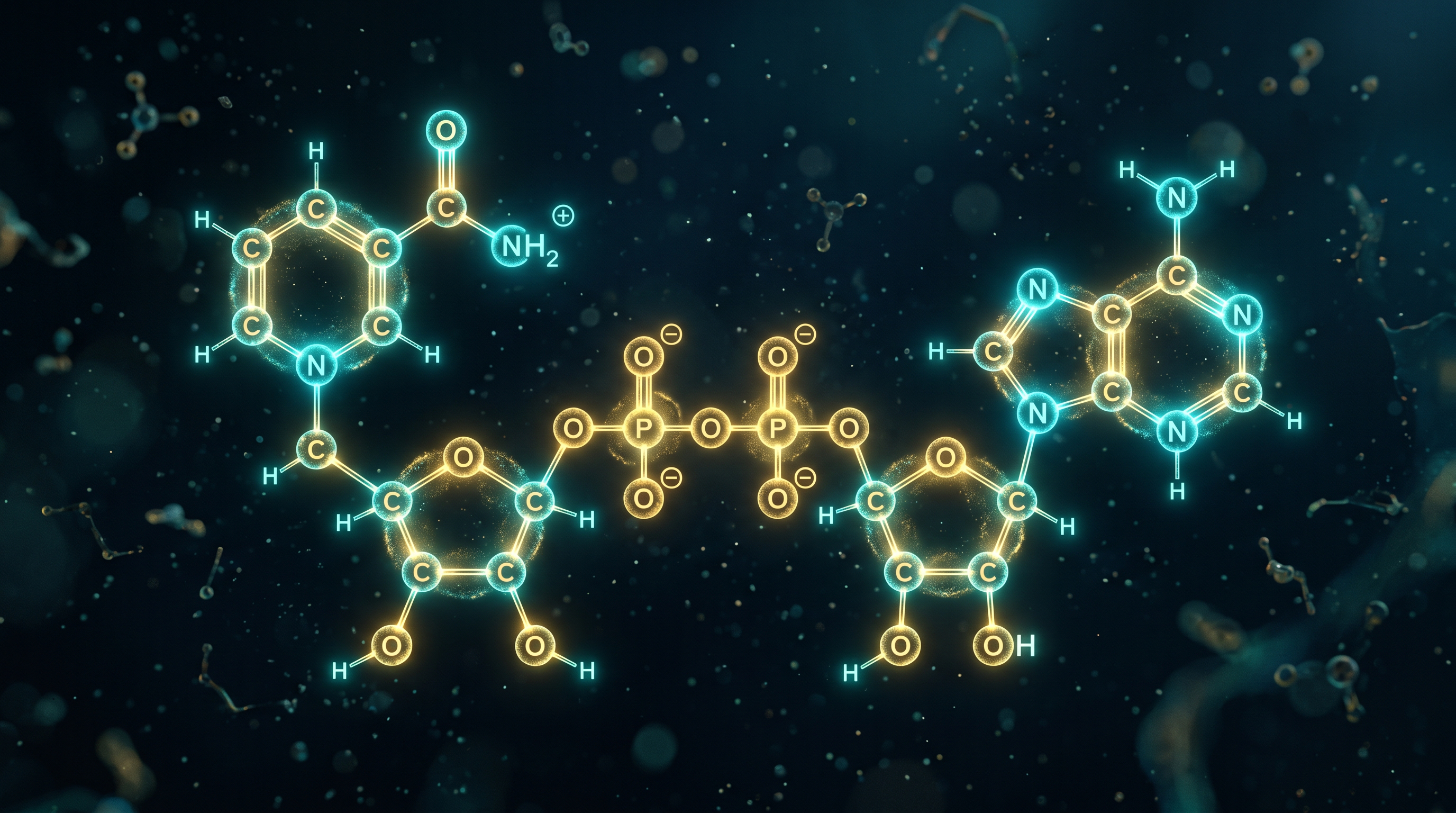
If you have spent any time reading about biohacking or longevity, you have seen the acronym NAD everywhere: in science podcasts, supplement stores, and aging research articles. But most of what is written about NAD starts at the supplement, not the biology.
This article starts from the beginning: what NAD does in every cell of your body, why its levels collapse with age, and which strategies have solid scientific backing to recover them, including some that cost nothing.
What NAD is and what it does in the cell
NAD (nicotinamide adenine dinucleotide) is a coenzyme present in every cell of every living organism, from bacteria to humans. It is not a nutrient in the usual sense: the body produces it internally from dietary precursors and uses it as a mediator in hundreds of metabolic reactions.
Its primary role is to transfer electrons between molecules in energy metabolism. More directly: NAD is a key piece in the process by which mitochondria convert nutrients from food into ATP, the cell's energy currency. Without sufficient NAD, cellular energy production deteriorates.
But the function of NAD that most interests longevity research is different: it is the fuel for sirtuins. Sirtuins are enzymatic proteins that regulate the epigenome (the instructions that tell each cell which genes to activate) and repair DNA when it suffers breaks. Without NAD, sirtuins cannot function. And without functional sirtuins, cellular aging accelerates.
NAD also powers PARP1, a DNA repair enzyme, and CD38, an immune system protein. Demand for NAD is constant and high: every cell consumes it and recycles it continuously.
Why NAD drops with age
By age 50, NAD levels in tissues and blood are approximately half of what they were at age 20. This decline is well documented across multiple human tissue types and animal models (Canto et al., Cell Metabolism, 2015).
It happens through two mechanisms that accumulate over time:
- The body produces less. The enzymes responsible for synthesizing NAD from its precursors, especially NAMPT, reduce their activity with age.
- Consumption increases. With aging, accumulated DNA damage and rising systemic inflammation increase the activity of enzymes such as CD38 and PARP1, which consume NAD massively. The result is a progressive deficit that synthesis mechanisms cannot compensate for.
The consequences are broad: lower mitochondrial energy efficiency, reduced DNA repair capacity, impaired epigenetic regulation, and higher baseline inflammation. It is not a single disease: it is the biochemical substrate of aging.
NAD and sirtuins: the connection that explains aging
Sirtuins are seven proteins (SIRT1 to SIRT7 in mammals) that depend directly on NAD to function. When NAD is abundant, sirtuins are active: they regulate the epigenome precisely, repair DNA, and control cellular metabolism. When NAD is scarce, sirtuins lose potency and cells begin to disorganize.
The review by Imai and Guarente in Trends in Cell Biology established this NAD-sirtuin axis as one of the most robust molecular markers of aging (Imai and Guarente, 2014). The decline of NAD is not only a consequence of aging: it is one of its causes.
A vicious cycle is at work: aging reduces NAD, reduced NAD inhibits sirtuins, inhibited sirtuins deteriorate the epigenome, and epigenome deterioration accelerates aging. That is why NAD is at the center of longevity research.
How to increase NAD naturally
Before considering supplements, there are three strategies with solid evidence to raise NAD at no extra cost:
- Intermittent fasting. Temporary energy restriction activates the AMPK pathway, which stimulates NAD synthesis and inhibits CD38, the enzyme that consumes the most NAD. Effects are documented with 14 to 16 hours of overnight fasting.
- Aerobic exercise. Moderate to high intensity exercise increases mitochondrial demand for NAD and, over time, raises synthesis capacity. High-intensity interval training (HIIT) has the most pronounced effect on NAMPT expression, the key NAD synthesis enzyme (Canto et al., 2015).
- Reducing chronic inflammation. CD38, the largest NAD consumer, is overactivated in the presence of systemic inflammation. A diet rich in vegetables and low in ultra-processed foods reduces that inflammatory load and slows NAD consumption.
Complete nutrition as the foundation of the NAD system
Satislent PRO includes vitamin B3 (niacin), a direct NAD precursor, along with all 26 essential micronutrients your body needs every day. Complete nutrition from just €1.75 per serving.
Discover Satislent PRONAD precursor foods: the foundation before supplements
NAD cannot be obtained directly from food, but the body synthesizes it from dietary precursors. The most direct and accessible is vitamin B3 (niacin). There are two main forms: nicotinic acid and niacinamide. Both are NAD precursors through the salvage pathway.
Foods with the highest content of vitamin B3 and tryptophan (another NAD precursor through the de novo pathway):
- Chicken and turkey. Among the richest sources of niacin. 100g of chicken breast provides around 60% of the daily reference intake for B3.
- Tuna and salmon. Tuna has one of the highest niacin contents of any food: a 100g tin can cover 100% of the daily reference intake.
- Peanuts. The richest plant-based source of niacin. 100g provides around 60% of the daily reference intake.
- Mushrooms. A notable plant-based source of niacin, especially portobello and shiitake varieties.
- Legumes. Provide tryptophan, an NAD precursor through the de novo pathway. Lentils, chickpeas, and beans are the richest.
- Oats. A source of both niacin and tryptophan, and a core ingredient in Satislent PRO.
One important point: micronutrient deficiencies can limit NAD synthesis even when B3 intake is adequate. The process also requires vitamins B2, B6, folate, and magnesium. Incomplete nutrition creates bottlenecks at different points in the metabolic chain.
NMN and NR: what the science says
The most popular supplements for raising NAD are NMN (nicotinamide mononucleotide) and NR (nicotinamide riboside). Both are more direct NAD precursors than niacin: NMN converts to NAD in the cell in a single enzymatic step.
In 2021, a double-blind clinical trial in postmenopausal women with prediabetes showed that supplementation with 250 mg/day of NMN for 10 weeks improved muscle insulin sensitivity and increased sirtuin activity in skeletal muscle (Yoshino et al., Science, 2021). This is the most cited and well-controlled human trial available.
What the science says honestly in 2026:
- NMN and NR supplements do raise NAD levels in humans. That is documented in multiple trials.
- The functional effect in healthy individuals is more limited than many sellers claim. Most trials showing clear functional results were conducted in people with metabolic deficits (diabetes, obesity, advanced age) or in animals.
- They are safe at studied doses. No significant adverse effects have been reported in published trials.
- They are expensive. A quality NMN supplement costs €50 to €100 per month. If the nutritional foundation is not in place, the supplement yields less return.
The logical sequence: first cover dietary NAD precursors (especially B3), activate the natural synthesis mechanisms (fasting, exercise), and reduce the inflammation that accelerates NAD consumption. After that, if there is interest and means, consider supplements.
Frequently asked questions
At what age do NAD levels start to decline?
The decline is gradual from age 30, but becomes statistically significant from age 40. By 50, NAD levels are approximately half of what they were at 20. The rate of decline can be modulated by lifestyle: regular exercise and intermittent fasting slow it down.
How many fasting hours are needed to raise NAD?
Studies in animals and humans show effects on NAD at 14 to 16 hours of fasting. This range is achievable simply by skipping breakfast and not eating until noon. Multi-day fasts are not required to get the NAD benefit.
Is taking vitamin B3 the same as taking NMN?
No. Vitamin B3 (niacin or niacinamide) is a NAD precursor through several metabolic steps. NMN is a more direct precursor: it is just one step away from NAD. NMN supplements raise NAD levels more efficiently per dose, but are much more expensive. Dietary B3 is the minimum base needed for NAD synthesis to function correctly.
Can NAD levels be measured in blood?
Yes, laboratory tests can measure NAD in whole blood or peripheral blood mononuclear cells. They are not routine tests in most healthcare systems, but some private laboratories offer them. Their clinical utility is still under study: blood NAD levels do not necessarily reflect what is happening in organs such as muscle or liver.
Are NAD supplement side effects a concern?
NMN and NR supplements have shown a good safety profile in published trials at doses up to 500 mg/day over several weeks. High-dose niacin (vitamin B3) can cause facial flushing — uncomfortable but not dangerous. Niacinamide (another form of B3) does not cause this effect. If you have pre-existing health conditions, consult your doctor before supplementing.
Conclusion
NAD is not a supplement trend. It is a central molecule in cellular aging, and its decline with age is among the most solid molecular markers we know. The good news is that much of that decline is modifiable, and the strategies with the most scientific backing cost nothing extra.
Order matters. First: cover dietary precursors (especially vitamin B3), reduce chronic inflammation with a quality diet, and activate natural NAD synthesis with intermittent fasting and regular aerobic exercise. NMN or NR supplements can be an additional step with growing evidence, but they do not replace the nutritional and lifestyle foundation.
If the body does not have the micronutrients the synthesis mechanisms need, the best supplements on the market will deliver less return.
The nutritional foundation of the NAD system
Satislent PRO includes vitamin B3 and all 26 essential micronutrients in every serving. The simplest way to cover the foundation before considering any supplement. From just €1.75 per serving, no cooking required.
Try the Tasting PackThis article is for informational purposes only. It does not replace advice from a healthcare professional. If you have specific health conditions, consult your doctor or nutritionist before taking supplements.
Updated: June 2026 | Satislent Editorial Team