

 Español
 Français
Your cart
There are no more items in your cart
Autophagy: the cellular cleaning process that only activates when you fast
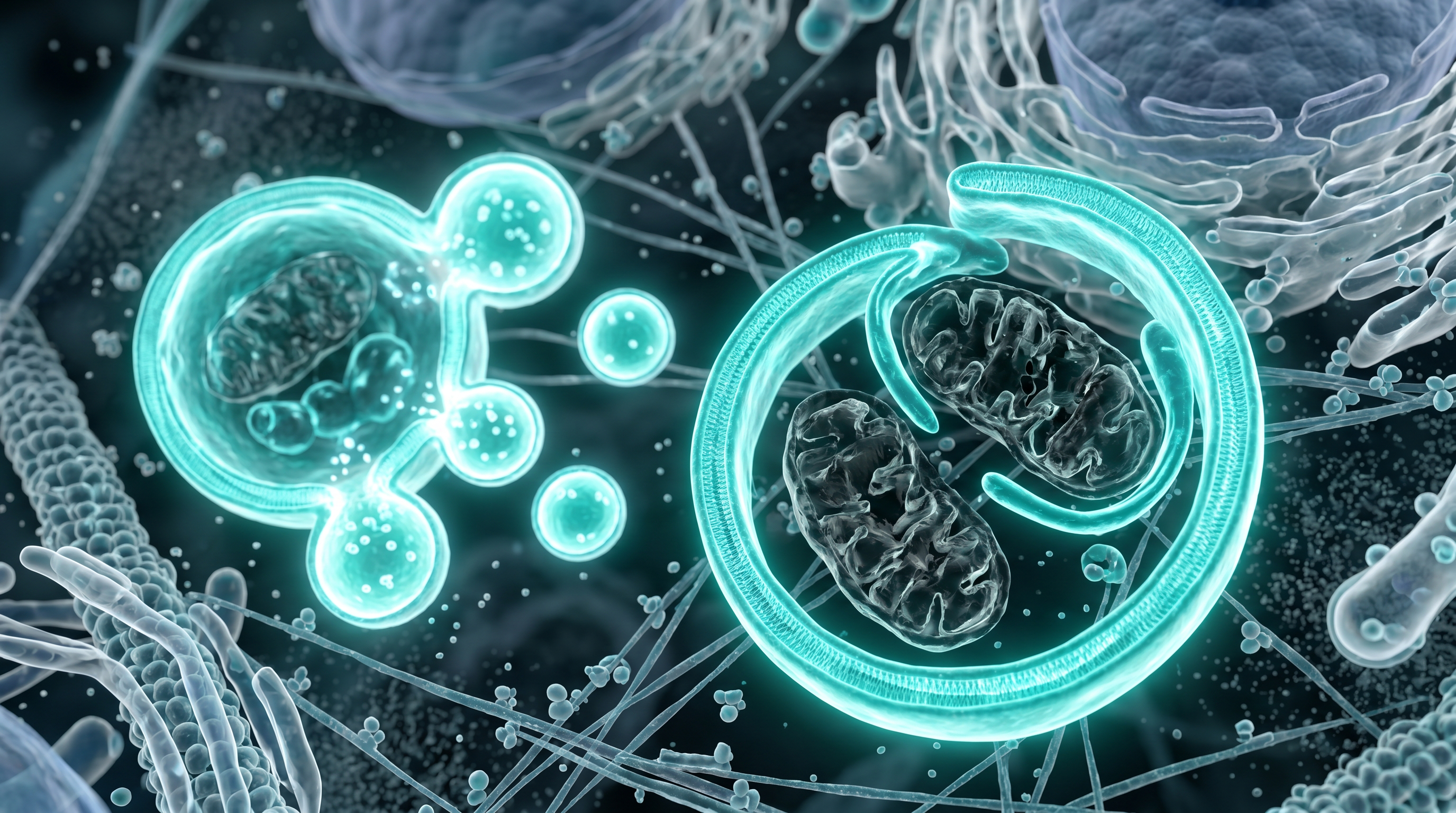
For decades, scientists knew that cells were breaking down their own components, but nobody fully understood the mechanism. In 2016, Yoshinori Ohsumi received the Nobel Prize in Physiology for deciphering exactly how this process works: autophagy. What seemed like esoteric cell biology turned out to have direct implications for how we age, how we get ill, and, crucially, how we can influence both through something as simple as not eating for a few hours.
The most important thing to understand about autophagy is this: it is suppressed when you eat. Every time you consume food, particularly protein and carbohydrates, you activate a molecular pathway called mTOR that halts cellular recycling. For your cells to clear their own waste, they need space. That space is called fasting.
What is autophagy
Autophagy (from the Greek autos, "self", and phagein, "to eat") is the process by which cells break down and recycle their own damaged or obsolete components. Dysfunctional mitochondria, misfolded proteins, membrane fragments, intracellular pathogens: all of these are engulfed in structures called autophagosomes, fused with lysosomes, and degraded to recover amino acids and other building blocks the cell can reuse.
It is not a process exclusive to stress situations: it occurs at a baseline level in nearly all cells in the body, but its rate multiplies when there is an energy deficit, infection, or cellular damage. Think of it as your body's waste management system: always running, but operating at full capacity when it is most needed.
There are three main subtypes. Macroautophagy is the most studied: a double membrane (the phagophore) forms around the material to be degraded and delivers it to the lysosome. Microautophagy involves direct uptake of molecules by the lysosome. Chaperone-mediated autophagy (CMA) selects specific proteins containing a recognisable sequence and translocates them directly into the lysosomal interior. All three mechanisms matter for health, though macroautophagy has received the most clinical attention.
The Nobel Prize discovery
Yoshinori Ohsumi, a researcher at the Tokyo Institute of Technology, spent decades studying autophagy in yeast. During the 1990s he identified the ATG genes (autophagy-related genes), the molecular machinery that orchestrates the entire process. The critical finding: those genes are evolutionarily conserved. What works in yeast works, with variations, in human cells.
The Nobel Committee recognised this in 2016, stating that the mechanisms discovered by Ohsumi are "key to understanding how the cell adapts to starvation and infection". You can read the full rationale on the official Nobel Prize website. Since then, autophagy research has grown exponentially: there are now more than 60,000 publications in PubMed citing the term.
The practical implication is straightforward: there is a cellular maintenance machinery that you can activate deliberately. Fasting is its primary switch.
How autophagy is activated: fasting, mTOR and AMPK
To understand when and how autophagy is activated, you need to know two key proteins: mTOR and AMPK.
mTOR (mechanistic target of rapamycin) is the central regulator of cell growth. When you eat, particularly when amino acids and glucose are present in the bloodstream, mTOR activates. Its role is to promote protein synthesis and growth. To do this efficiently, it inhibits autophagy: when resources are abundant, the cell builds rather than recycles.
AMPK (AMP-activated protein kinase) is the cellular energy sensor. When ATP levels drop, whether because you have been fasting for hours or because you are exercising intensely, AMPK activates. Its effect is the opposite of mTOR: it promotes energy conservation and triggers autophagy.
The mechanism is essentially a two-position switch. Fed state: mTOR on, AMPK off, autophagy suppressed. Prolonged fasting: mTOR off, AMPK on, autophagy engaged. As Levine and Kroemer documented in Cell (2008), this duality between growth and cellular recycling sits at the core of how cells maintain homeostasis over time.
Exercise also activates AMPK and can induce autophagy through a slightly different pathway involving local ATP depletion in muscle tissue.
How many hours of fasting do you need to trigger autophagy
This is the question most people search for, and the honest answer is: it depends, but there are solid reference points.
Autophagy is not a binary on/off switch. It increases progressively as the fast extends and blood glucose and insulin levels fall.
- 8 to 12 hours. Liver glycogen begins to deplete and insulin levels fall steadily. mTOR starts to deactivate. Baseline autophagy is maintained but does not increase significantly.
- 12 to 16 hours. Autophagy markers begin to rise in a measurable way. Human muscle biopsy studies confirm significant elevations of autophagic markers in this range.
- 24 hours. Alirezaei et al. (Autophagy, 2010) demonstrated that a 24-hour fast doubled neuronal autophagy levels in animal models. Human data in this range is consistent with deep activation.
- Beyond 24 to 48 hours. Autophagy reaches very high levels, but the risks of muscle catabolism and metabolic imbalance also increase. This range is only recommended under medical supervision.
The practical takeaway: a 16:8 intermittent fasting protocol (16 hours fasting, 8-hour eating window) is sufficient to activate autophagy regularly without risk for most healthy adults. You do not need multi-day water fasts for the process to work.
When you break your fast, quality matters
Satislent PRO delivers 30 g of complete plant protein, vitamins and minerals in under 2 minutes. Everything your cells need to rebuild after the fasting window, from just €1.75 per meal.
Discover Satislent PROHealth benefits of autophagy
The list of potential benefits associated with autophagy in the scientific literature is extensive, but it must be read carefully: most mechanistic research has been carried out in animal models. Clinical trials in humans are more limited and, in many cases, still ongoing.
- Cellular renewal. The degradation of damaged components and the recovery of materials for reuse is autophagy's primary function. In tissues with high cell turnover, such as the liver and intestinal epithelium, this process is particularly active.
- Neurological function. Deficient autophagy is associated with accumulation of protein aggregates such as tau and amyloid beta (Alzheimer's) and alpha-synuclein (Parkinson's). The review by Mizushima and Levine in the NEJM (2020) identifies autophagic dysfunction as a common factor in several neurodegenerative diseases.
- Immune response. Autophagy (in its xenophagy form) eliminates intracellular pathogens and regulates inflammatory responses. Some studies suggest improved resistance to infections when autophagy is optimised.
- Metabolic health. Autophagy contributes to insulin sensitivity and lipid metabolism, which explains part of the metabolic effect of intermittent fasting beyond simple caloric restriction.
Important: EFSA has not approved health claims for interventions specifically based on autophagy. The benefits described reflect mechanisms studied in peer-reviewed literature, not therapeutic claims.
Autophagy and longevity: what the science says
The connection between autophagy and longevity is one of the most active fields in ageing biology, and also one of the most overstated in popular media.
What is solid: in model organisms (yeast, nematodes, flies, mice), activating autophagy through caloric restriction or mTOR inhibition with rapamycin consistently extends lifespan. In mice, rapamycin administered at midlife produced a 9 to 14% increase in life expectancy, according to Harrison et al. in Nature (2009).
What remains uncertain in humans: there is no direct evidence that deliberately activating autophagy through fasting extends human lifespan. Epidemiological studies on caloric restriction and longevity are consistent but confounded by multiple variables. Long-term human intervention studies are scarce.
What is reasonable to conclude: there is strong mechanistic coherence between autophagy, cellular maintenance, and healthy ageing. Intermittent fasting, which activates autophagy regularly, has growing evidence of metabolic benefits in humans. Extrapolating from that to "you will live longer" is a step the current science has not conclusively taken, and any content asserting this without nuance is misrepresenting the data.
How to enhance autophagy without compromising your nutrition
The risk of focusing entirely on fasting is forgetting what happens when you eat. The eating window is just as important as the fasting period. These are the factors that maximise autophagy without compromising health:
- Regular exercise. Both resistance training and moderate aerobic exercise activate AMPK and stimulate autophagy in muscle, liver and brain, independently of fasting.
- Complete nutrition when breaking the fast. When you exit the fasting window, your cells need building blocks to regenerate. A meal with complete protein and adequate micronutrients allows the recycling cycle to be complemented by effective synthesis.
- Black coffee without sugar. Preliminary evidence suggests coffee may enhance autophagy even during fasting without breaking it. The probable mechanism is AMPK activation by methylxanthines.
- Avoiding constant snacking. Continuous snacking keeps insulin elevated and mTOR chronically active, reducing natural autophagy windows. A meal structure with at least 12 hours of overnight fasting already activates the process.
What you should not do: prolonged fasts without medical supervision if you have diabetes, a history of eating disorders, are pregnant, or have any chronic condition. Autophagy does not justify skipping meals to the point of sustained nutritional deficit.
The goal is not to be in constant autophagy: it is a cycle. You activate the process during the fast, and when you eat, your body uses the recycled materials alongside the nutrition you consume to rebuild more effectively. Cleaning without repair does not work.
Frequently asked questions
How long do you need to fast for autophagy to start?
Studies indicate that autophagy begins to increase measurably from 12 to 16 hours after the last meal. Deeper activation is observed from 24 hours onwards. A 16:8 protocol is sufficient to activate it regularly without risk for healthy adults.
Are there any signs that your body is in autophagy?
There is no reliable home biomarker. Some practitioners of prolonged fasting report heightened mental clarity and the presence of ketone bodies (ketone breath), which are correlates of the fasting metabolic state but do not directly demonstrate autophagic activity. Measuring autophagy requires biopsy or laboratory techniques.
Does breaking your fast with protein stop autophagy?
Yes. Eating, especially protein and carbohydrates, reactivates mTOR and slows autophagy. This is normal and desirable: the goal is a cycle between autophagy and anabolism, not a permanent state of recycling. When you break the fast, the body switches to synthesis and repair mode, which is equally necessary.
Does autophagy help with fat loss?
Indirectly. Autophagy itself is not a fat oxidation mechanism. However, the fasting that activates it does use fatty acids as an energy source. The metabolic benefits of intermittent fasting, including improved insulin sensitivity, contribute to better body composition over the long term.
Is it safe to induce autophagy through fasting?
For healthy adults, 16:8 fasting is considered safe by most clinical guidelines. People with diabetes, eating disorders, pregnancy, or chronic conditions should consult their doctor before starting any fasting protocol.
Conclusion
Autophagy is one of the best-documented cellular mechanisms of the past thirty years, and fasting remains the most studied and accessible way to activate it. The evidence establishes that 12 to 16 hours of fasting is sufficient for regular activation, without the need for extreme protocols.
What makes autophagy robust as a concept is not that it is a wellness trend: it is a fundamental biological function, backed by the 2016 Nobel Prize and thousands of peer-reviewed publications. What remains uncertain is the precise quantification of its long-term benefits in humans, something research is progressively resolving.
The piece that is often forgotten in the fasting narrative is what you eat when you open the eating window. If fasting activates cellular cleaning, post-fast nutrition determines the materials with which you rebuild. Quality counts, and that is half the equation.
Try Satislent with no commitment
The Taste Pack includes 6 complete meals in all flavours and formats for €23. Discover how it fits into your fasting routine before committing to a full bag.
Try the Taste Pack for €23This article is for informational purposes only. It does not replace advice from a healthcare professional. If you have specific health conditions, consult your doctor or nutritionist.
Updated: June 2026 | Satislent Editorial Team